Cappadocia is not a place where you visit a single landmark and move on. It’s a place where history is spread across valleys, hidden inside rocks, and waiting along walking paths. And the churches are at the center of that experience. If you’re exploring the region, you’ll quickly notice something. Churches are everywhere.
Some are part of well-known sites like Göreme Open Air Museum. Others appear unexpectedly while walking through valleys like Rose Valley or Ihlara Valley. They don’t always look impressive from the outside.
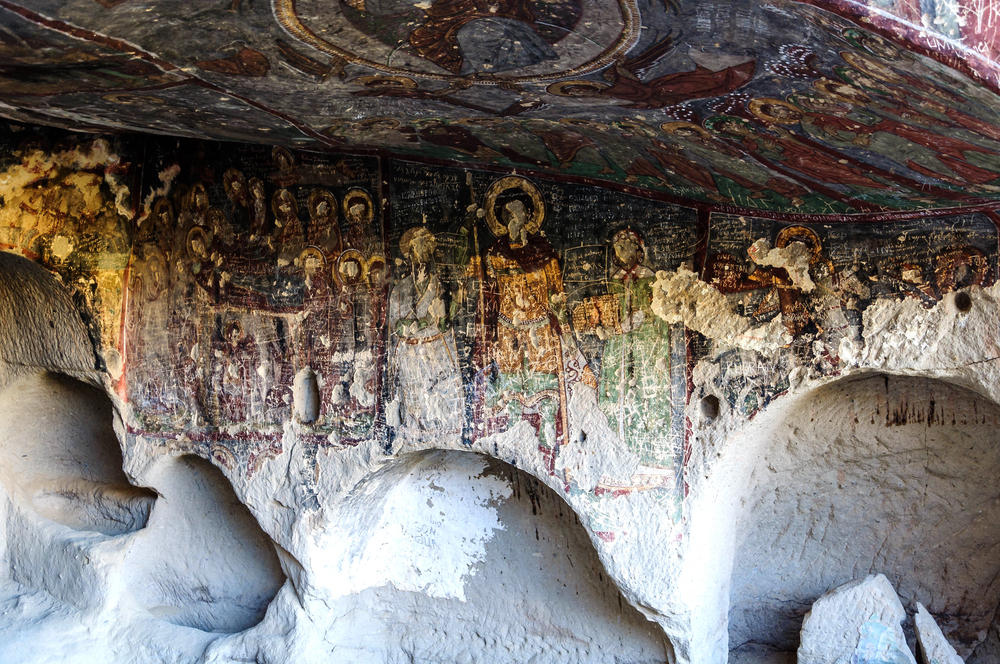
But once you step inside, the atmosphere changes. Frescoes, carved walls, and quiet spaces give you a glimpse into how people lived and worshipped here centuries ago.
According to UNESCO World Heritage Centre, Cappadocia is recognized for this unique combination of natural formations and human history, with hundreds of rock-cut religious structures preserved across the region.
What makes these places special is not just their age. It’s how they are experienced. You don’t walk through a formal museum. You move between valleys, climb into rock-cut spaces, and discover churches one by one.
Cappadocia4U Team Insight:
“In Cappadocia, the churches are not separated from the landscape. They are part of it, and that’s what makes exploring them so memorable.”
No Regrets Booking Advice
In this guide, we’ll explore the must see churches, monasteries, and chapels across Cappadocia, so you can plan your visit with a clearer idea of what to expect and where to go.
At a Glance: Churches in Cappadocia
Cappadocia is one of those places where history is not hidden in museums. It’s carved directly into the landscape. Over thousands of years, different civilizations lived here. From the Hittites and Persians to the Seljuks and Ottomans, each left something behind. Not in the form of large cities, but inside the rock itself.
That’s what makes this region feel different.
The land was shaped by volcanic eruptions, creating soft rock that people could carve and use. Over time, this turned Cappadocia into a network of underground spaces, cave homes, and most importantly, rock-cut churches.
And many of them are still standing today.

According to UNESCO World Heritage Centre, Cappadocia is listed as a World Heritage Site due to its unique combination of natural formations and cultural history, with hundreds of preserved structures across the region.
But what makes these churches special is not just their number.
It’s their variety.
Each one feels different. Some are small and simple, hidden along valley paths. Others are larger, with detailed frescoes covering the walls and ceilings.
You don’t need to be deeply interested in religious history to appreciate them.
The atmosphere, the artwork, and the setting are enough.
Cappadocia4U Team Insight:
“Cappadocia’s churches are not just places to visit. They are spaces that make you slow down and notice the details around you.”
Whether you’re exploring valleys or visiting open air museums, these churches, monasteries, and chapels add depth to your experience.
And once you start noticing them, they become one of the most memorable parts of your trip.
Churches at the Goreme Open Air Museum in Goreme
If there is one place where you can understand Cappadocia’s religious history in a single visit, it’s Göreme Open Air Museum. This is not just a collection of churches. It’s a compact valley where monastic life once took place.

As you walk through the site, you move between rock-cut churches, small chapels, and shared living spaces carved into the soft volcanic rock. Everything is close together, which makes it easy to explore, but each structure feels different.
According to UNESCO World Heritage Centre, this area is part of Cappadocia’s World Heritage listing, known for preserving some of the most important Byzantine cave churches in the region.
Inside, the focus shifts to the walls.
Frescoes cover ceilings and interiors, telling stories from the Old and New Testament. Scenes of Christ, saints, and early Christian life appear layer by layer as you move from one church to another.

Some are simple. Others are detailed and surprisingly well preserved.
Cappadocia4U Team Insight:
“Göreme Open Air Museum is not about one church. It’s about how many different styles and stories you can see in one place.”
Among the most visited are:
- Dark Church
- Apple Church
- Tokalı Church
- Snake Church
- El Nazar Church
Each one adds a different layer to the experience.
Dark Church (Karanlık Kilise)
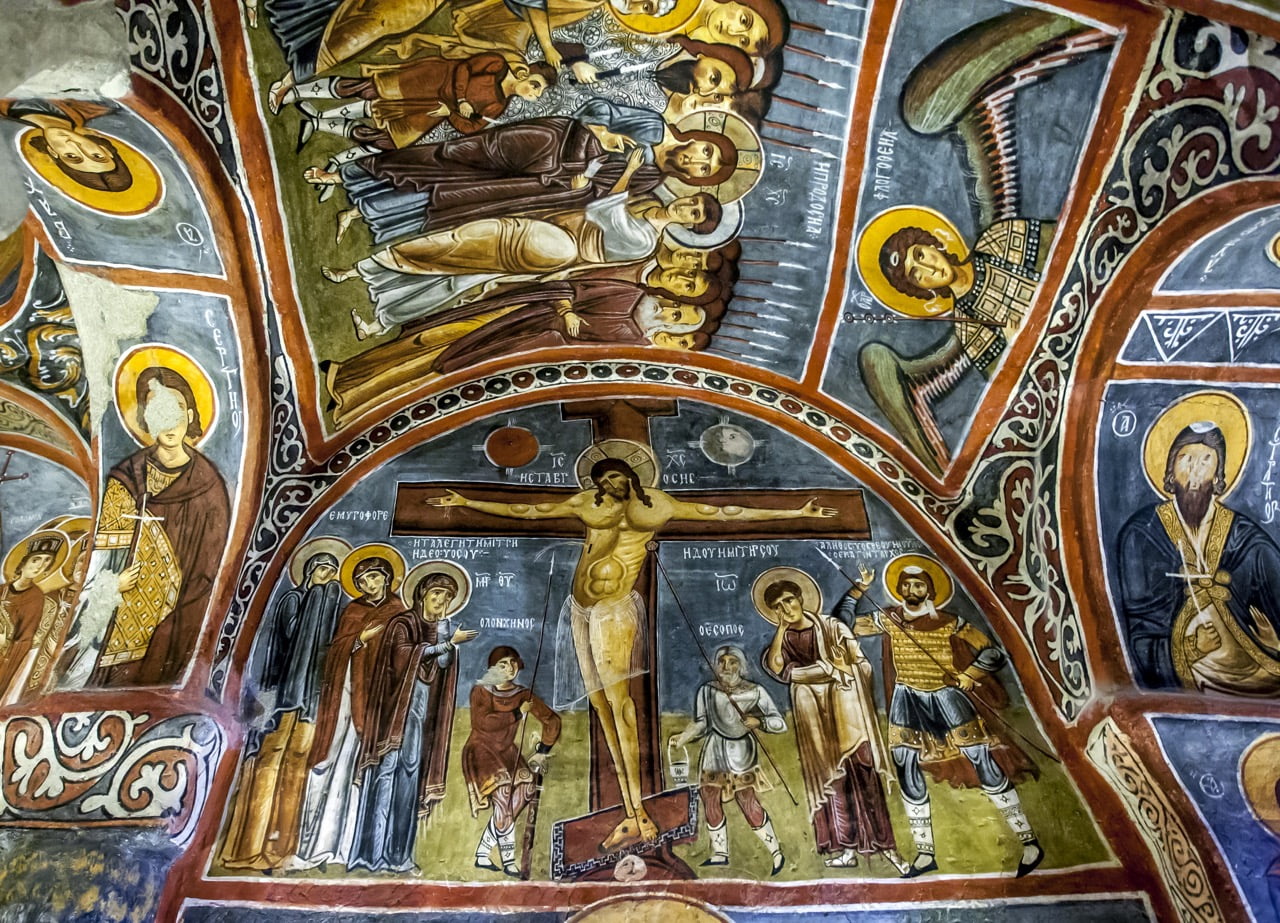
The Dark Church is often considered the highlight of the entire museum. And it’s easy to see why.
Because of limited light exposure over centuries, the frescoes inside have remained remarkably vivid. Colors are deeper, details are clearer, and scenes feel more complete compared to other churches.
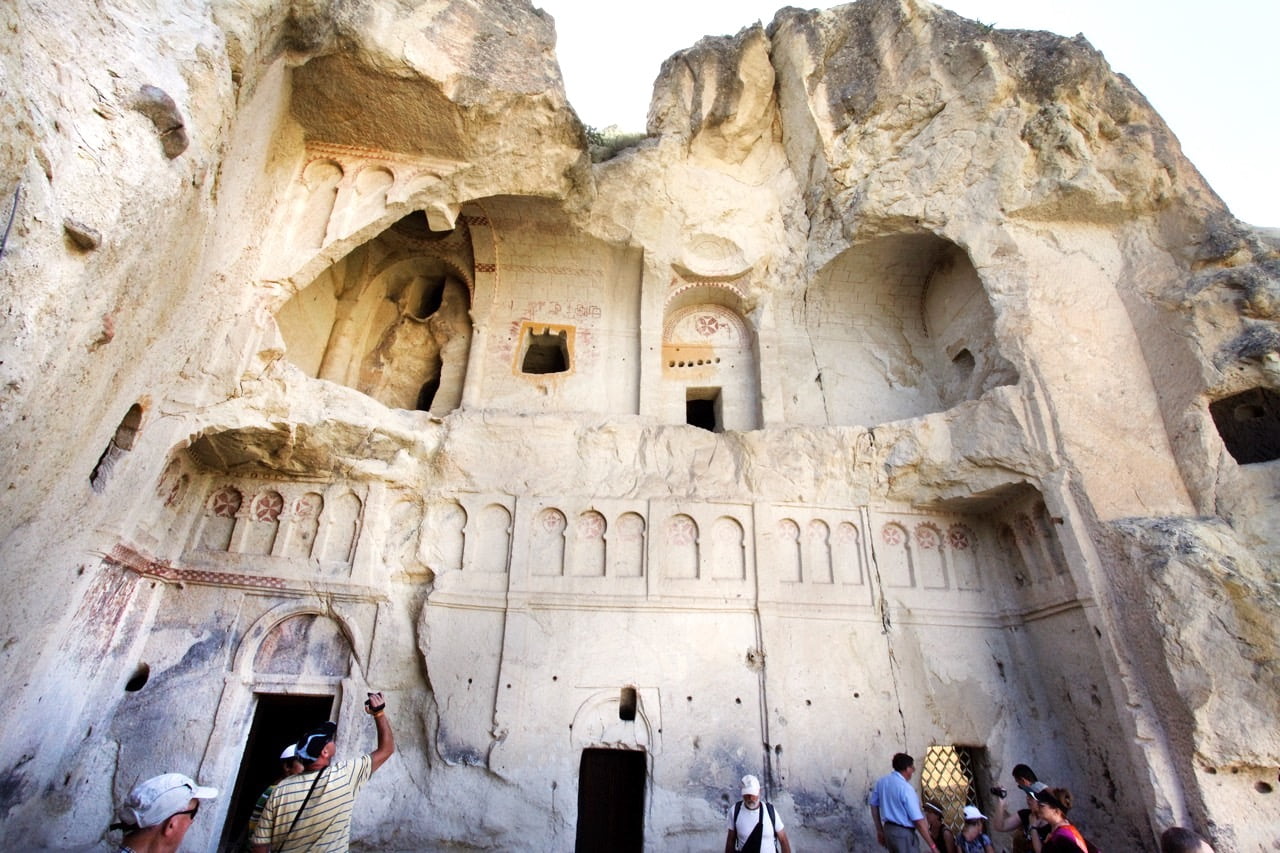
You’ll see depictions of the Crucifixion, the Last Supper, and other key moments from the life of Christ, dating back to the 12th and 13th centuries.

There is an additional entrance fee to access this church, but most visitors find it worth it.
Cappadocia4U Team Advice:
“If you only choose one extra ticket inside the museum, choose the Dark Church. The difference in fresco quality is immediately visible.”
Apple Church (Elmalı Kilise)
The Apple Church is smaller, but it has a distinct atmosphere. Built around the 11th century, the church features a central dome supported by four irregular pillars forming a cross-shaped layout.

Its frescoes include scenes of Christ, angels, and saints, with one of the most recognizable details being the image of Jesus holding an apple.

It’s not the largest church in the complex. But it’s one of the most balanced in terms of structure and artwork.
Tokalı Church (Buckle Church)
The Tokalı Church is the largest and one of the most detailed churches in the area. It stands out immediately.

The interior feels longer and more open, and the walls are covered with extensive fresco cycles showing the life of Jesus.

Some of the artwork here dates back to the 10th century, making it one of the oldest and most significant churches in Cappadocia.
The use of color, especially deep blues, makes it visually distinct from others.
Cappadocia4U Team Insight:
“Tokalı is the church where you start noticing how detailed and complex these spaces really are.”
Snake Church (Yılanlı Kilise)
The Snake Church is known for its symbolic imagery. Inside, you’ll find frescoes of saints and biblical figures, including a well-known depiction of St. George slaying a dragon.

The artwork here feels slightly different. More narrative. More symbolic. It’s a smaller church, but it adds variety to your visit.
El Nazar Church
The El Nazar Church stands slightly apart from the main cluster. It’s smaller, but historically interesting.

Inside, you’ll see frescoes depicting the Crucifixion and other biblical scenes. The setting feels more isolated compared to the central churches in the museum.


What makes it unique is its context. Nearby, you’ll notice elements reflecting Cappadocia’s layered cultural history, including later additions that show how the area evolved over time.
Cappadocia4U Team Advice:
“El Nazar is easy to miss, but it’s worth a short stop. It adds a different perspective to the main churches.”
The churches at Göreme Open Air Museum are not meant to be rushed. Each one offers something slightly different.
And together, they create one of the most complete experiences of Cappadocia’s religious and cultural history.

Chapels in Pasabag Monks Valley– between Avanos and Goreme
In Paşabağ Monks Valley, the experience feels simple at first. You walk between the famous fairy chimneys. Then you notice something different. Some of them are not just formations. They were used.

One of the most striking examples is the three-capped fairy chimney at the center of the valley. Inside, you’ll find a small chapel space connected to the story of Saint Simeon, who is believed to have lived here in isolation for years.
It’s not large. It’s not decorated like the churches in Göreme. But it feels personal.
Cappadocia4U Team Insight:
“Paşabağ is where you see how people adapted the landscape for solitude, not just community life.”
Churches in Rose Valley (Gulludere)– near Goreme
Rose Valley offers a more spread-out experience. You don’t walk into a single site. You follow paths. At some point, the valley splits. One direction leads to quieter monastic chambers, while the other takes you toward a few of the most well-known churches in the area.
The atmosphere feels different here. Less structured. More open. And the churches appear gradually as you walk.
Church of Three Crosses
The Church of Three Crosses is small, but memorable.


Its name comes from the three crosses depicted in its frescoes, along with scenes from the life of Jesus. The artwork is not as vivid as in Göreme, but the setting inside the valley adds to the experience.
Ayvali Church

Ayvalı Church feels more detailed. Its frescoes include saints and biblical scenes, and although the interior shows signs of age, the structure and layout still stand out.
Cappadocia4U Team Advice:
“In Rose Valley, the churches are part of the walk. You discover them, rather than visit them directly.”
Churches in Swords (Kiliclar) Valley– near Goreme
Swords Valley is known for its sharp rock formations. But hidden within the valley, you’ll also find small churches. The most notable are the Kılıçlar Church and the Virgin Mary Church.

They are not large. But they add depth to the landscape.

You’re not just looking at formations. You’re stepping into spaces that were used for worship and daily life.
Churches in Cavusin Village
Cavusin village is one of the oldest settlements in the region. And that history is visible. The village itself is small, but the churches here are among the oldest you’ll see. The Church of St. John the Baptist, dating back to the 5th century, stands out as one of the earliest examples in Cappadocia.

Nearby, the Çavuşin Church features frescoes that reflect important events and figures from the period. From a distance, especially at sunset, the entire village feels like part of the landscape.
Cappadocia4U Team Insight:
“Çavuşin is not just about the churches. It’s about seeing how early communities lived around them.”
Churches in Zelve Valley– between Avanos and Goreme
Zelve Valley feels wider and more open than other valleys. There are around 15 churches scattered across the area.
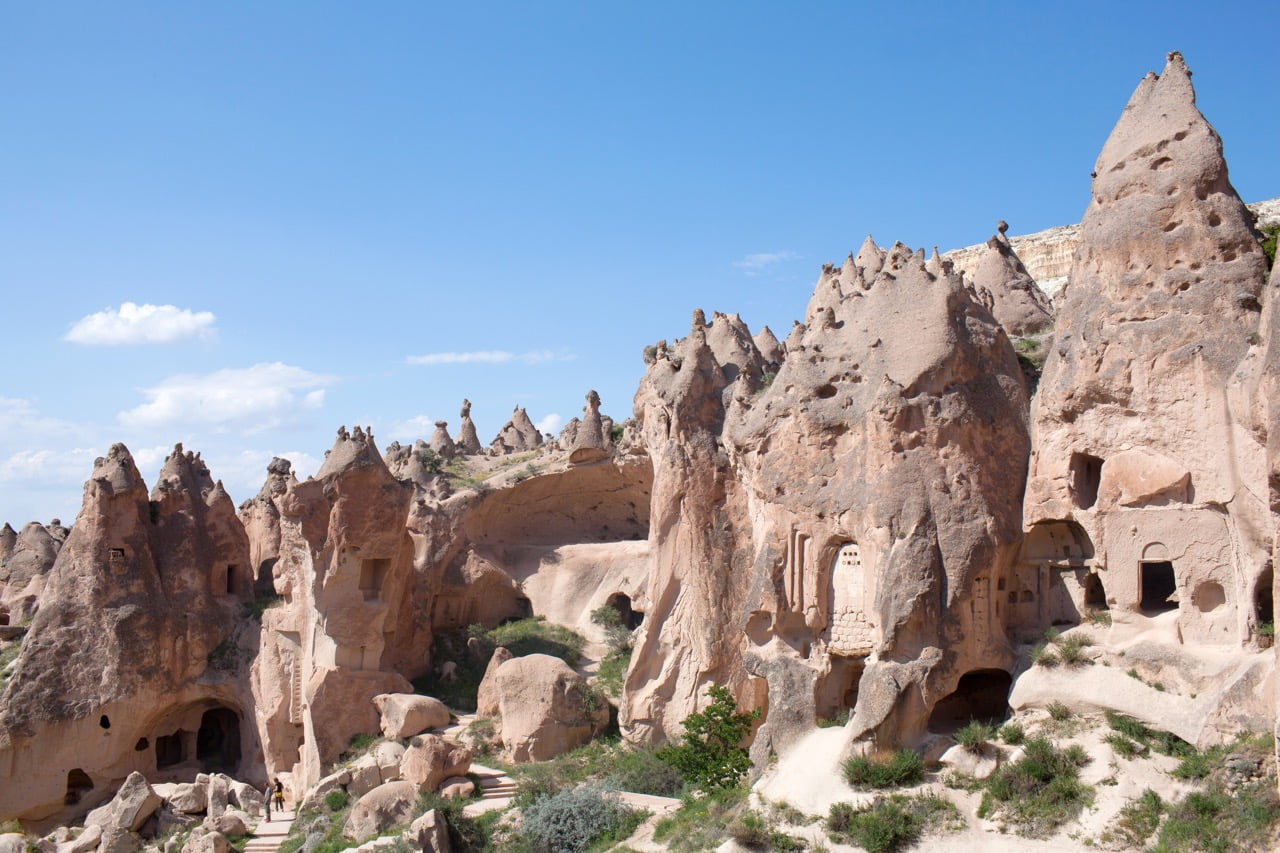
Some of the most interesting include:
- Üzümlü Church, known for grapevine motifs in its frescoes
- Balıklı Church, with fish symbols linked to early Christian imagery
- Geyikli Church, featuring animal figures and biblical scenes
These churches are more spread out. You don’t visit them all at once. You encounter them as you explore the valley.
Uzumlu Church with the Grape
The Uzumlu Church (also known as the Church with the Grape) features frescoes depicting the life of Jesus and the Twelve Apostles. It’s unique because of its depiction of grapevines, which was a common motif in the region’s Byzantine art.

Churches, Monasteries and Chapels in and around Ihlara Valley
Ihlara Valley offers a completely different setting. Here, churches are not grouped together. They are hidden along a canyon.

As you walk beside the river, you come across small entrances carved into the rock. Inside, you’ll find spaces used for worship, many with traces of frescoes.
Among the most notable are St. George Church and Kirkdamaltı Church. Both stand out for their historical and artistic value.

Selime Monastery – 1 km. after Yaprakhisar village on the exit of Ihlara Valley
At the end of the valley, you reach Selime Monastery. This is not a single church. It’s a large complex. Carved into the rock, it includes chapels, living spaces, tunnels, and open areas. The scale feels different from anything else in the region.


Caves in rock in Selime Monastery, Ihlara Valley, Cappadocia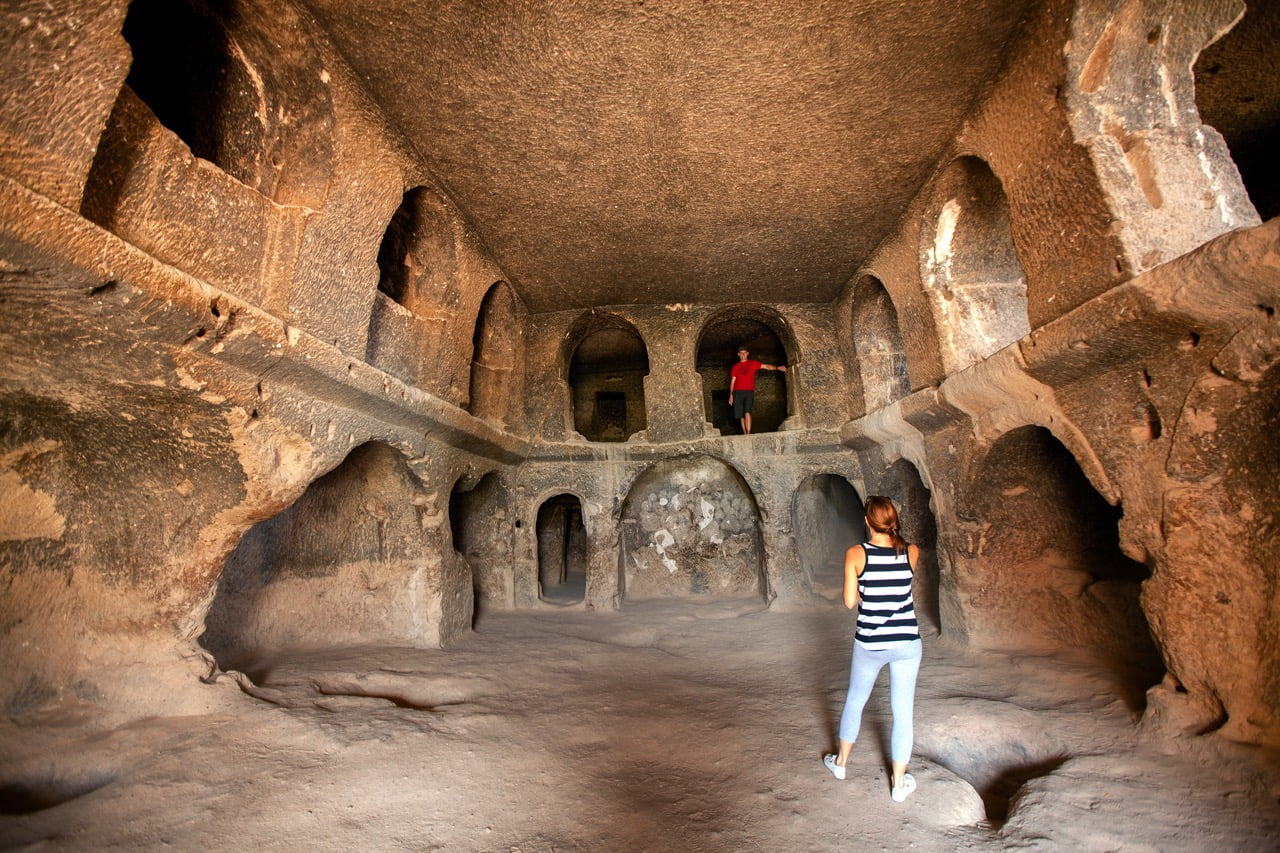
Built around the 13th century, it is considered one of the largest religious structures in Cappadocia. You can climb to higher sections for wide views across the valley.
Cappadocia4U Team Advice:
“Selime is where everything becomes larger. After smaller churches along the valley, the scale here feels completely different.”
Cappadocia’s churches are not limited to one place. They are spread across valleys, villages, and hidden paths. Some are easy to reach. Others require a bit of walking.
But together, they create one of the most unique cultural landscapes you can explore.
Visiting Churches, Monasteries & Chapels Itinerary
Planning how to visit Cappadocia’s churches can feel overwhelming at first. There are hundreds of them. You don’t try to see everything. You group them by location and follow a logical route.
That way, visiting churches, monasteries and chapels in Cappadocia becomes a smooth and enjoyable experience instead of a rushed checklist.
1-day itinerary (highlights route)
If you only have one day, focus on the most concentrated areas. Start with Göreme Open Air Museum in the morning. It gives you the strongest introduction with multiple churches in one place. Make sure to see Dark Church there.
Then move to Çavuşin Village to see early examples like St. John the Baptist Church.
Continue toward Paşabağ Monks Valley for a different perspective with small chapels inside fairy chimneys.
Finish your day in Zelve Valley, where churches are spread across a wider landscape.
2-day itinerary (balanced experience)
With two days, you can slow down and explore more deeply. Day 1 follows the same route as above. Day 2 focuses on valleys.
Start in Rose Valley, where churches appear along hiking paths. Then move to Swords Valley for smaller, less visited churches. End your day with sunset in the valley.
3-day itinerary (full experience)
If you have three days, you can include one of the most unique areas. Dedicate one day to Ihlara Valley.
Here, churches are hidden along a canyon walk rather than grouped together. It feels completely different from Göreme.
At the end of the valley, visit Selime Monastery, one of the largest religious complexes in the region.
Common Traveler Questions
Which churches in Cappadocia are must see?
If you have limited time, start with Göreme Open Air Museum. It includes several of the most important churches in one place. Beyond that, Rose Valley, Zelve Valley, and Ihlara Valley offer additional churches in more natural settings.
Do you need a ticket to visit Cappadocia churches?
It depends on the location. Sites like Göreme Open Air Museum require an entrance ticket. Some valleys and smaller churches are free to access. Certain churches inside museums, like the Dark Church, may require an extra fee.
What is the most famous church in Cappadocia?
The Dark Church is often considered the most famous. Its frescoes are among the best preserved in the region, with vivid colors and detailed biblical scenes.
Are the frescoes still visible?
Yes, in many places. In well-preserved churches, especially inside Göreme Open Air Museum, frescoes are still clearly visible. In more remote valleys, some have faded over time, but you can still recognize figures and scenes.
Can you visit Cappadocia churches without a guide?
Yes. Most churches are easy to explore on your own. Paths are marked, and access is straightforward. That said, having basic background knowledge helps you understand what you’re seeing.
How long should you spend visiting churches in Cappadocia?
It depends on your itinerary. You can spend 1 to 2 hours at a single site like Göreme Open Air Museum. If you explore valleys such as Rose Valley or Ihlara Valley, it can turn into a half-day experience.
Are Cappadocia churches crowded?
Some are. Popular places like Göreme Open Air Museum can get busy, especially during peak hours. Valleys and smaller sites tend to feel much quieter.
What should you wear when visiting churches?
Comfortable walking shoes are important. Many churches are located along trails or uneven paths. Light clothing works well, but bringing a layer is helpful for cooler areas inside caves.
Are these churches still used today?
Most are not active places of worship. They are preserved as historical and cultural sites. Their main purpose today is to be visited and appreciated for their history and artwork.
